
The COA, the Gymfluencer, and the Citizen Scientist
On chemical safety in a post-truth era



Can you think of any part of a COA more enthusiastically discussed than the test results for a given peptide’s purity?
Take a look at online forum chatter about a suspicious lab or a bunk batch. You’d think these comments were written by a ‘roided-out James Joyce or an Ozempic-faced Virginia Woolf:
COA’s got peaks all over the place, man, basically sprinkled with homeopathic fairy dust. Endotoxin city, bought it at TrashTier so yeah got what I paid for. Batch is bunk, straight-up garbage peptides, COA’s copypasta from last year lmao how did u miss this. Bathtub brew. Back-alley synthesis. Play stupid games, win stupid prizes. COA says 99%, your body says copium. It’s like endotoxin soup. It’s like endotoxin chowder, man who knows what’s floating in there. Random mystery powder, amino acid daisy chain, no way that’s legit, terrible separation on the HPLC…
I could go on, but I’m sure you get the point. When it comes to assessing the quality of a given batch of research peptides, purity is the foremost criterion on the COA, the one that everyone pays attention to – and arguably, the one that inspires the most fear among a given lab’s clientele.
To be clear, these fears aren’t exactly unfounded. If that deconstituted powder in the vial is going to have any sort of experimental contact with a biologic system (or systems), it’s certainly worth knowing that the powder is the same thing that its label purports it to be. But as with so much online discourse, the real truth lies in the nuance.
We’ve reported this before here at Peptide Partners Corner: a high purity rating on a given batch of peptides isn’t everything. It’s crucial to understand that popular purity screenings like High-Performance Liquid Chromatography (HPLC) and mass spectrometry are fundamentally incapable of screening for endotoxins:
The Hidden Danger in High-Purity Peptides: Why Endotoxin Testing Is Non-Negotiable

The Purity Paradox That’s Putting Lives at Risk
Chapter 85 of the United States Pharmacopeia (USP 85) specifies the mandatory testing protocol for bacterial endotoxins in pharmacological substances, none of which are HPLC and mass spectrometry. So the wordy, dissatisfied research chem customers are altogether wrong to think that a given sketchy lab’s falsified COA could meaningfully reflect the presence of endotoxins in their peptides. (Though they wouldn’t be wrong to infer that a lab producing impure peptides would more than likely lag behind on its sanitation and endotoxin screening as well.)
So what are purity tests actually measuring? If you’re a loyal reader of our Substack, you’ll probably remember this article that broke down the parts of a viable COA. Put simply, your average purity test runs a chemical ID on a given batch of peptides to determine the mass amount of the substance matching that ID.
Let’s say that I’m a vendor, and I tell you I’m going to sell you a 3ml vial of retatrutide with an alleged potency of 20mg/ml. Perhaps you’re suspicious of me, so you decide to send it off to a lab for independent testing. The lab runs a test on my retatrutide that confirms your fears: though the vial appears full when reconstituted, there’s only 30mg-worth of material in it that matches the chemical ID for retatrutide. The rest is just unknown filler. This means not only that my retatrutide’s potency is just 10mg/ml as opposed to the 20mg/ml I claimed, but that it’s mixed with substances of unknown origin. In other words: it’s weak and impure, but we don’t know exactly what’s making it that way unless we add more chemical ID determinants to our test.
More on the necessity of independent verification:


Peptide Research, Done Cleanly — Peptide Partners. Independent HPLC/MS, batch COAs, and endotoxin screening to USP <85> validate identity and purity of peptides for research. Browse inventory and view certificates at Peptide Partners.
So what’s the science behind HPLC and mass spectrometry? There’s a whole lot of pressurization, ionization, high-tech measurement of molecular speed, and in some cases, high-tech measurement of molecular UV absorption. But unpacking the chemistry of these processes is the remit of lab scientists. What we’re concerned with here is understanding why consumers so afraid of purchasing bunk or impure peptides continue to swallow misinformation and overlook questionable COAs while continuing to purchase bunk and impure peptides in daunting quantities.
(Amino) Chain of Fools
The rapidly expanding peptidesphere contains very few players with solid backgrounds in analytical chemistry. Thousands of words of this very Substack have been dedicated to elucidating how someone like the gym bro influencer with the “triple stack” of retatrutide can exert the sort of social pressure that inadvertently derails legitimate scientific progress.
Wellness Optimizers and Self-Experimenters: The Peptide Wild West

This is part three of a four-part series. Read parts one and two below:
Now, let’s go ahead and consider that very example step by step. Say a well-known gymfluencer with an illustrious bodybuilding career and a massive fan base receives what amounts to a sponsorship deal from a notoriously untrustworthy vendor looking to launder its reputation by purchasing social media legitimacy.1 The resulting chain of events is predictable, but no less invidious:
The influencer tells his 2 million followers to buy large amounts of untested retatrutide from a vendor that recycles shoddy COAs but is happy to pay influencers handsome commissions.
The influencer’s followers buy the influencer’s Clinically Proven™ TripleStackReta in droves, inject it, and become ill from bacterial endotoxins that the vendor never bothered to test for.
ERs across the country are flooded with young men experiencing flu-like symptoms from the endotoxins in the TripleStackReta. A few unlucky customers have severe inflammatory responses that necessitate hospitalization, and these make the news.
The news stories travel from local outlets to major networks and ultimately gain purchase on social media. A headline like COULD THE PEPTIDE BOOM BE THE NEXT PUBLIC HEALTH CRISIS? appears in the New York Times.
RFK Jr. gives a cryptic press conference decrying the FDA for “suppressing peptide research” while announcing that he (and, of course, the FDA) will be going after the “exploiters of human need” currently furnishing the grey market with untested research chemicals.
The outcome: several vendors spanning the range of integrity from dubious to trustworthy get slapped on the wrist or raided by the FDA; scientific grant money for peptide research gets slashed, with pro forma austerity reasoning cited; corporate monopolies on certain compounds tighten (e.g. semaglutide/Ozempic and tirzepatide/Zepbound); longevity-enhancing experimental peptide protocols continue to be enjoyed by the ultra-rich and no one else.
As you can see, impulse-purchasing “research-use only” peptides from a vendor without the faintest understanding of what real scientific research is can have a profoundly negative impact on the actual work being done in the fields of chemistry and biogerontology to understand the powerful healing properties of peptides and make them safe and accessible to people who might stand to benefit from them.
It doesn’t matter if the gymfluencer has millions of followers, if he’s best friends with Andrew Huberman or can bench 280. If he’s promoting bunk peptides through a bad vendor, he’s forestalling scientific progress. And you’re doing the same if you buy them from him.
Recognizing Trustworthiness
How to know who to trust in the peptide world? It’s one thing to search for vendors – or even journalists and commentators – who demonstrate a modicum of interest in the actual science behind peptides (as opposed to their cosmetic benefits). But nowadays even scientific expertise can be convincingly faked (hello ChatGPT).
So where to find the real experts? Take a look in the margins: the quote-tweets and restacks correcting the lazy, garbled half-truths of would-be science writers.
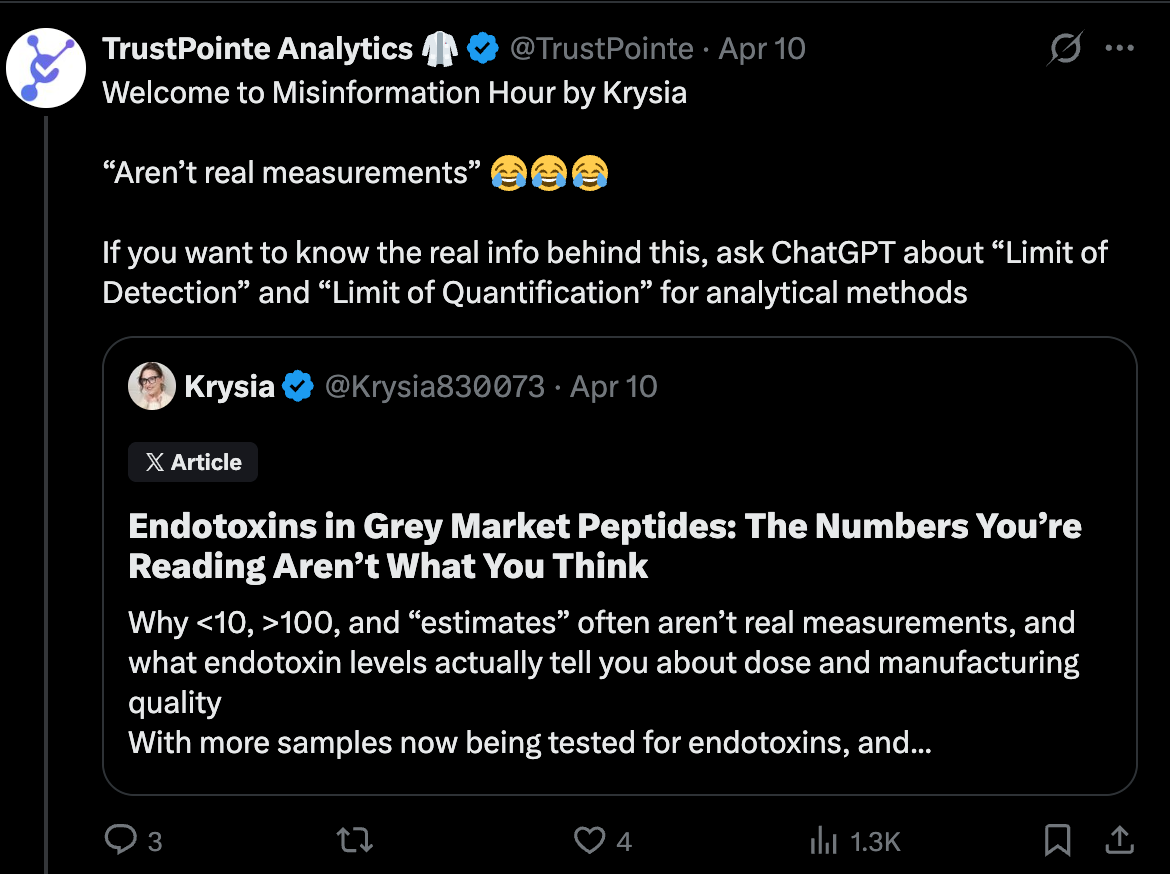
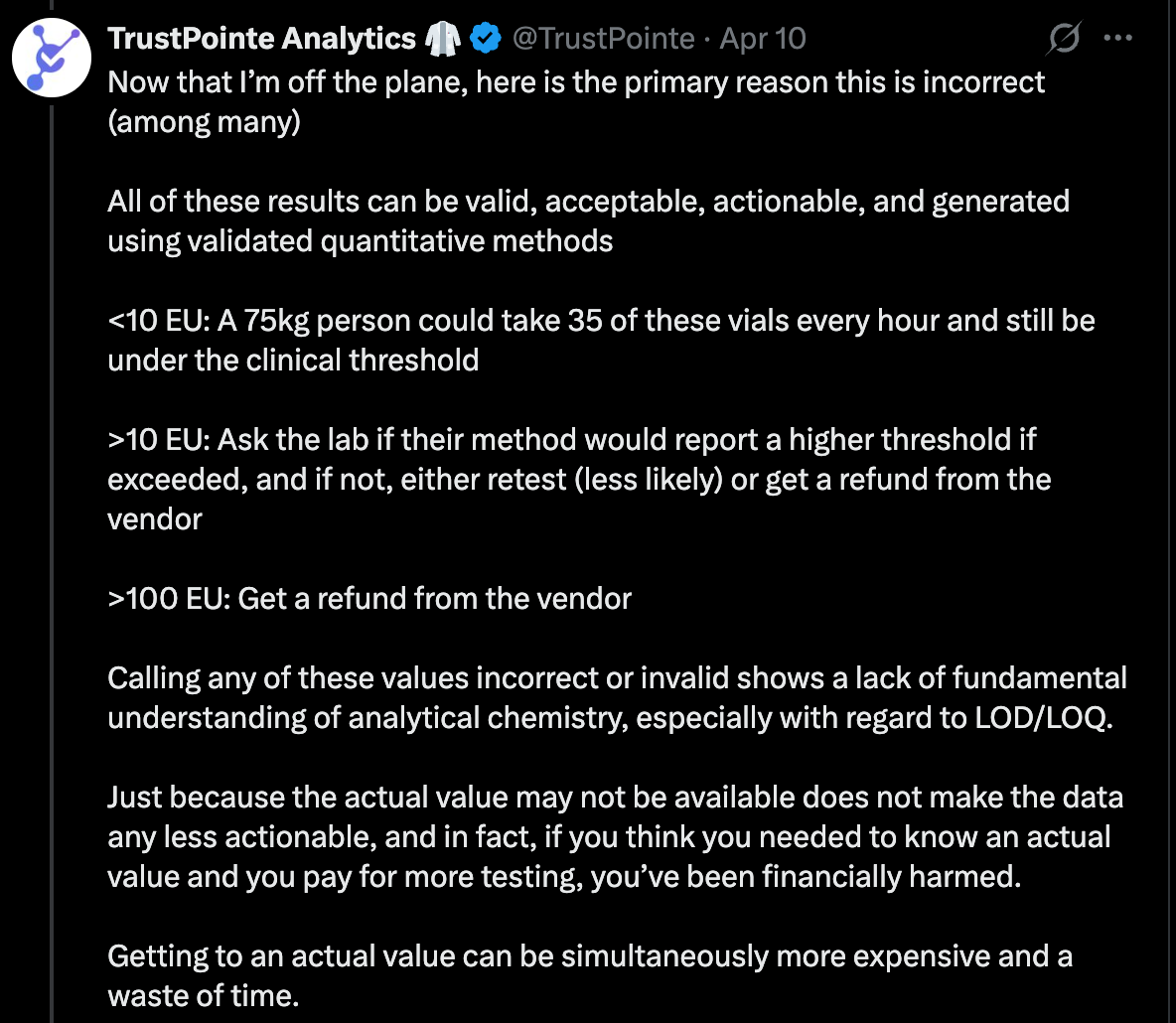
Here we see an analytical chemist correcting the half-truths of a member of the peptide world’s online commentariat.2 What appears at first glance to be an intelligent article about endotoxin measurement in peptide samples is in fact riddled with inaccuracies.
“All of these [allegedly invalid] results can be valid, acceptable, actionable, and generated using validated quantitative methods,” the TrustPointe chemist writes, and goes on to offer a helpful breakdown of the detection and quantification of endotoxins in samples using endotoxin units (EU).
Had I simply taken the prior tweet at face value without bothering to read the chemist’s quote-retweet, I would never have learned about Limit of Quantification and Limit of Detection, valuable principles in understanding how analytic chemists screen for endotoxins, and how those screenings translate to the quantitative results I encounter on my peptides’ COA.
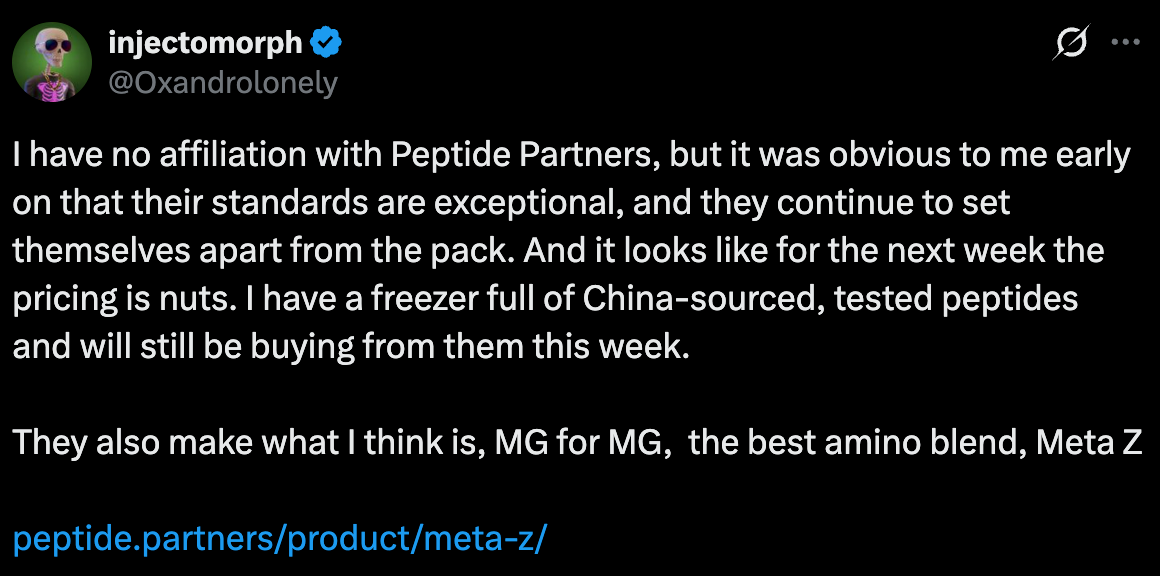
Continuing to use X like an ad hoc STEM research library, I may decide to learn a bit more about the vendors TrustPointe is working with. Take a look at the below from our very own Peptide Partners:
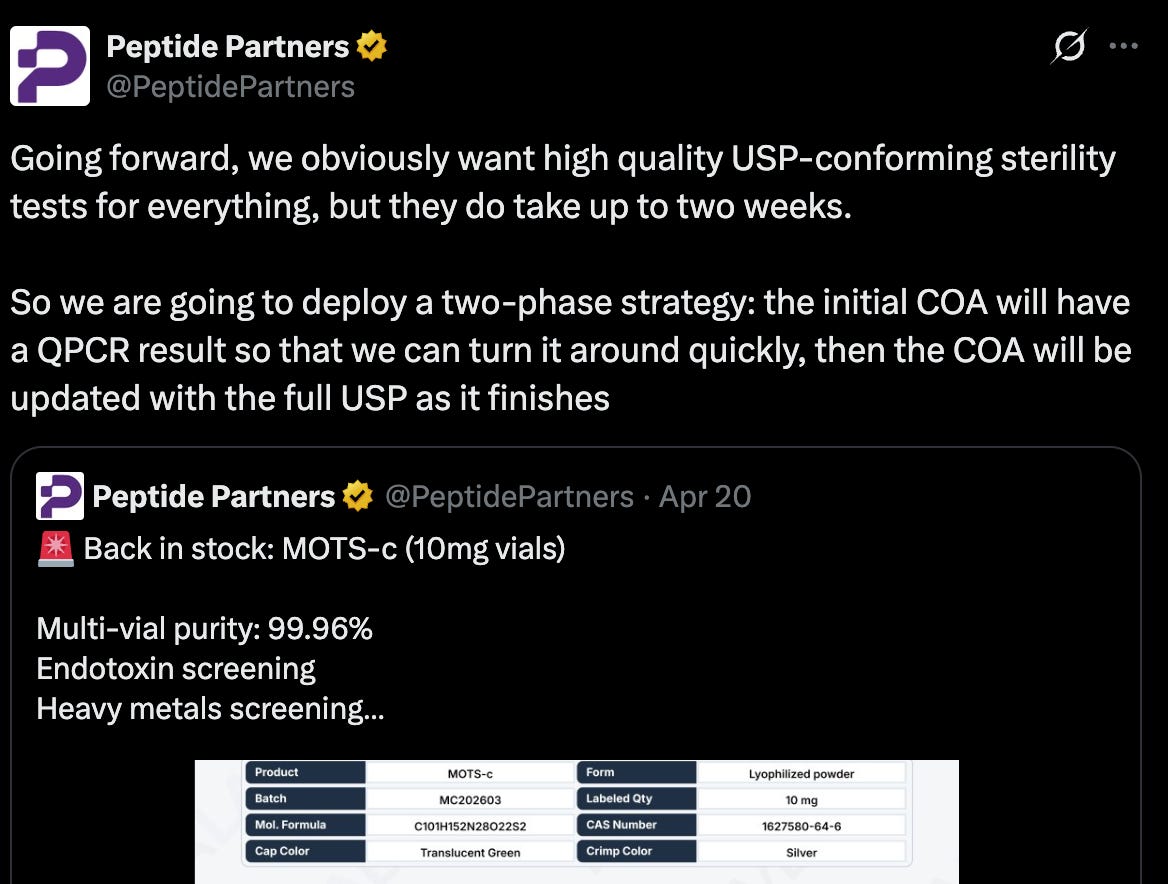
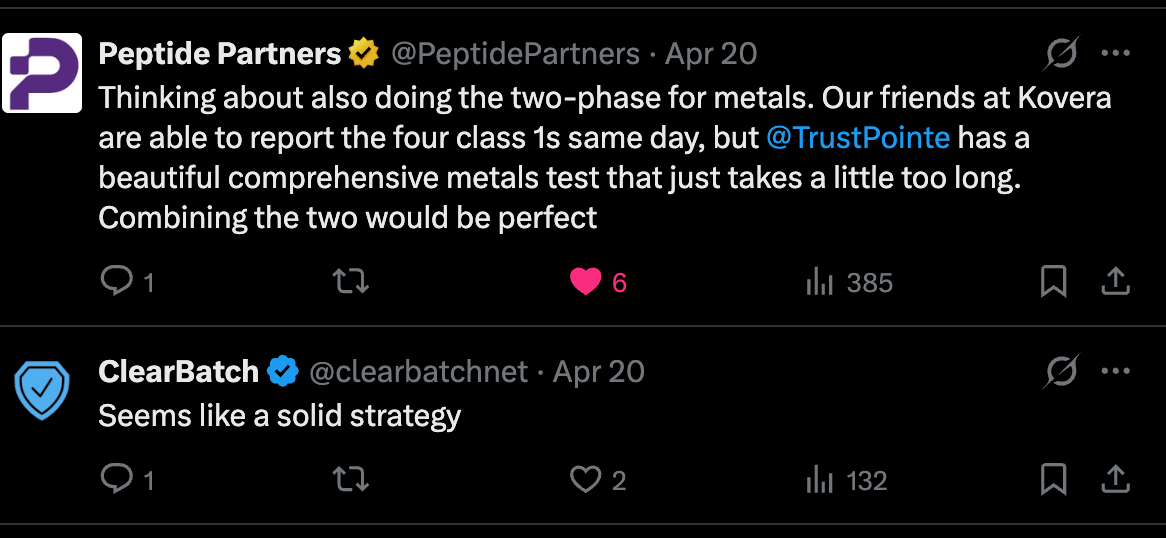
This fact-checking chemist does a comprehensive metals test for a vendor that’s willing to prioritize safety in a commercial space where “speed” is the watchword and convenience is prioritized at all costs. And furthermore, this vendor is willing to go the extra mile and pay two separate labs for heavy metal and endotoxin screenings that deliver a picture of a given peptide batch far fuller than “here’s the mass amount of peptide X in your vial, enjoy.”
This isn’t just immaculate quantitative analysis, as any member of Gen Z would say. It’s also real, bankable trustworthiness, the kind that makes a vendor’s name among its competitors. Prioritization of safety, compliance with regulatory guidance and oversight, and a rigorous understanding of the scientific backbone of the COA all make for a healthy peptide practice.
Hold research chemical vendors to the same standard you’d hold the research scientists who design those compounds. Because at the end of the day, the human body is a highly reactive organism deserving of more care than mega-profiteers are willing to provide it. None of us needs an advanced degree in chemistry to recognize that.
Money that would probably be better spent on keeping its facility sanitary and up to code, as well as paying for independent testing on every batch of peptides produced. But hey, what do we know?
A creator who once had a weird and great podcast (especially loved the Tinky Winky Quadrilogy voiceovers) but has clearly since gone the way of LLM-generated thought-putrefaction.
Hey — I came across your writing and really liked how you think.
I’m exploring something similar from a different angle — writing about human behavior through a system design lens (like debugging internal patterns).
Just started publishing on Substack. If you ever get a moment to read, I’d genuinely value your perspective.
Also happy to support your work — feels like there’s an interesting overlap here.