
Wellness Optimizers and Self-Experimenters: The Peptide Wild West
A multi-part series about the peptide world's unregulated gray market

This is part three of a four-part series. Read parts one and two below:


Part 3: Wellness Optimizers and Self-Experimenters
A sense of “outsiderly” desperation is just one of many factors driving people to purchase peptides in the ethically dubious and potentially dangerous world of gray market group buys. There’s also been a marked cultural shift in how Americans think of health and longevity – a shift that shares some ideological DNA with attitudes infallibility emerging from Silicon Valley’s risk-hardy culture of innovation at all costs.
In an interview on the Bloomberg podcast Odd Lots, San Francisco tech and culture reporter Jasmine Sun described the prevailing attitude she’d observed among young tech founders as one of “high risk tolerance.” Sun had witnessed members of the tech community taking non-FDA approved peptides purchased through gray market Chinese vendors. Some had even boasted about “having a guy in China” or knowing a “peptide dealer.” Sun admitted to being a bit weirded out by the cavalier vibe, especially when it comes to injecting one’s body with foreign substances of debatable provenance.
“Almost everyone I spoke to [about this], I’d ask, ‘Hey, are you scared? Are you worried?” Sun told Odd Lots. “And most of them would tell me, ‘I have a higher risk tolerance than most people…I’m the kind of person who doesn’t really need to wait until I’m given permission to do something, whether that’s by a regulator, or by some boss.”
This is a mentality that we’ve seen serve founders well since the early days of the tech boom in the mid-aughts: wresting expertise from the hands of experts (and questioning the very notion of “expertise” altogether); forging ahead with experiments, pitches, and prototypes instead of waiting for a senior partner’s advice or approval. Moving fast and breaking things, in other words – an approach that requires more than a little arrogance and foolhardiness, but has been proven time and time again to generate massive payoffs. Why not take a risk – even an extraordinary one – and get rich? Order a Tesla robotaxi, start a Zoosk profile, buy a self-driving car? Use yourself as the human test subject, like Blueprint founder Bryan Johnson did by taking the cancer drug rapamycin or injecting stem cells? Embrace the future, in other words, instead of trying to recapture a swiftly vanishing past?
“I think San Francisco is really leaning into its identity these days of not being the place that’s suffering under the regulatory decelerationist burden that’s plaguing the rest of the Western world,” Sun said. “And I think peptides are a part of that.”
Innovation, futurity, and an enthusiasm for deregulation are parts of the Silicon Valley Weltanschauung that have never had trouble gaining purchase in the U.S. government, or in the broader culture at large. Secretary of Health and Human Services RFK Jr. has been an outspoken proponent of sovereignty on the national and individual levels when it comes to matters of health. In addition to his famously controversial views on vaccine mandates, he also opposes WHO mandates that would grant unelected international bodies the ability to interfere with American self-reliance, and supports both Indigenous self-determination and tribal sovereignty, especially when it comes to bodily integrity.
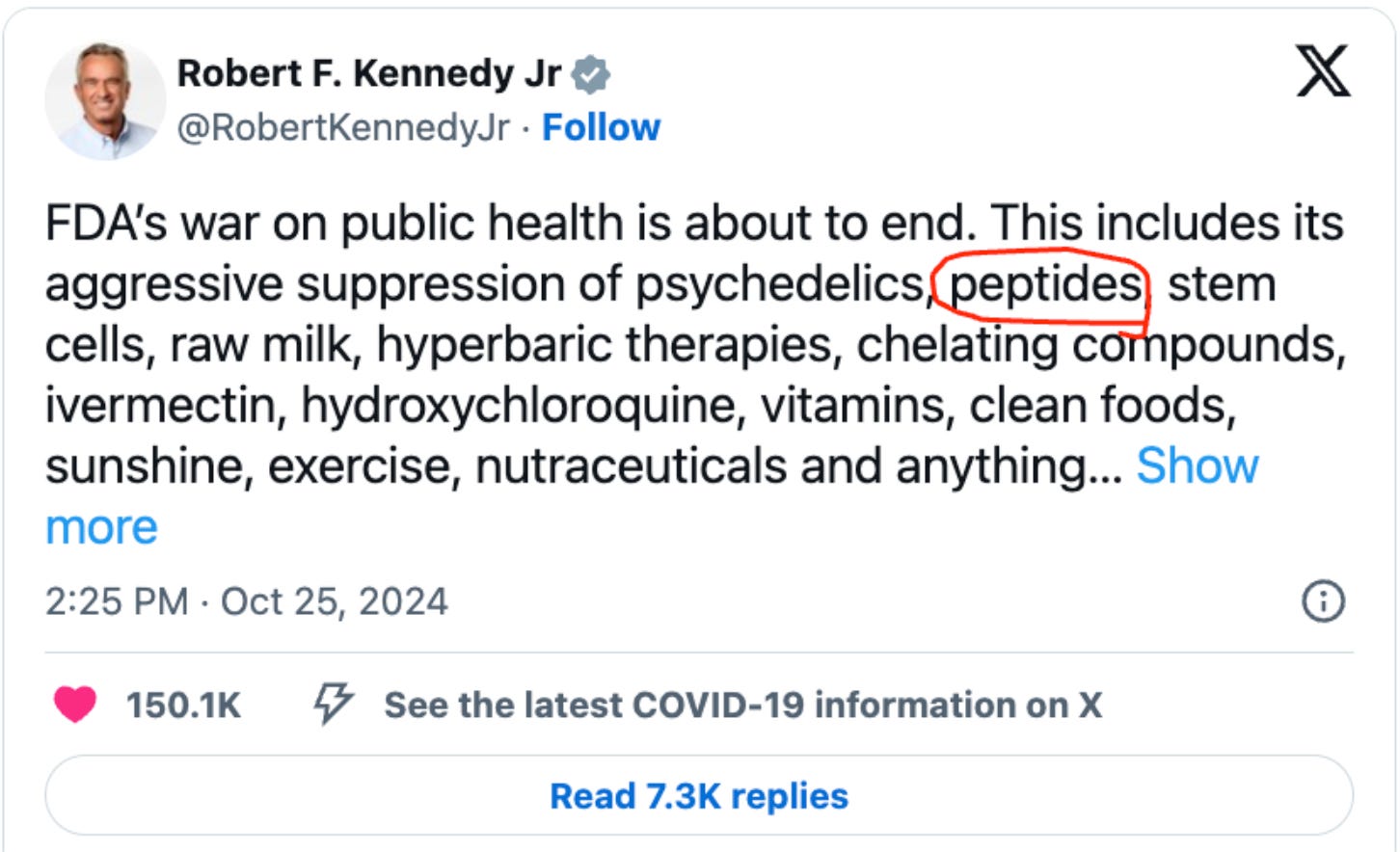
Notably, RFK Jr. is also an enthusiastic proponent of peptides. He has strongly advocated the benefits of BPC-157, and claimed that the FDA is suppressing useful peptides. RFK Jr. is good friends with biohacker, longevity enthusiast, and Ultimate Human founder Gary Brecka, who is well-known for his support of both BPC-157 and Sermorelin, which stimulates the production of HGH. RFK Jr. and Brecka have engaged in other wellness practices together, like trying a hyperbaric oxygen chamber and intravenous nutrition drips at Brecka’s penthouse.
Influencers like Brecka and RFK Jr. interlocutor Joe Rogan are for many the public face not just of peptide use, but of the broader wellness movement. Some may know it as MAHA (Make America Healthy Again), an RFK Jr. term they picked up not from the HHS Secretary himself, but from the constellation of influencers and podcasters surrounding him. “Momfluencers” like Vani Hari – whose Food Babe blog intends to expose harmful food additives not disclosed on product labels, among other things – and Zen Honeycutt – founder of the anti-GMO nonprofit Moms Across America – provide a feminine compliment to the decidedly male-dominated longevity and wellness sphere online. But Hari and Honeycutt share something crucial in common with popular biohackers like Andrew Huberman and “immortal unc” Bryan Johnson: a deep and abiding suspicion of “big pharma” and federal regulatory agencies like the FDA and CDC.
In many ways, this attitude is a mirror of a broad public sentiment that has been percolating since COVID. We all watched while half the country assiduously embraced masking mandates while the other half rejected them. And then we all watched with increasing anxiety as the pandemic progressed and the masked camp claimed non-maskers were inflicting a “genocide” upon the imnunocompromised, while the unmasked camp claimed masking mandates were “unconstitutional,” and an infringement of their civil rights. For many of us, that anxiety became horror pursuant to the following: 1) the CDC changed its recommended COVID isolation period from ten days to five, citing only “what we currently know about the Omicron variant”; 2) medical practitioners began opening up about the impact of ruthless market incentives on FDA-approved COVID treatments.
On the heels of unmitigated public health emergencies like the opioid crisis, the twin epidemics of depression and loneliness, and working class/impoverished America’s persistent lack of access to nutritious food, public faith in the federal government’s ability to protect the health of the American populace is at an all-time low. An Axios/Ipsos American Health Index poll taken in October of last year revealed that only 54% of respondents found the CDC trustworthy (as opposed to 66% in December 2024), and only 47% still trust federal food safety standards as advanced by the FDA.
Add to all of this the distrust of clinical expertise emerging from within medical spaces. Naturopath and chiropractic physician Dr. Tyna Moore has decades of experience working with peptides, hormone replacement therapy, and other anti-aging and anti-inflammatory protocols. On a recent episode of her podcast, she reports being badgered by colleagues who didn’t understand why she turned some patients away for treatment. They accused her of “taking away hope” from her patients, which struck Moore as a dangerous thing to say. “These procedures are not covered by insurance under any circumstances, they are expensive, they are invasive, they are potentially risky…why would I put someone through that if they weren’t primed and ready to receive that treatment, and have the best outcomes possible?”
Moore is keen to remind potential patients that peptides should be taken under clinical supervision, and that the most effective peptide protocols are the ones administered to patients who have made lifestyle chances – eating, sleeping, activity – that will prime their bodies to benefit from those treatments. But Moore is one of very few voices in a sea of influencers crowing about their weight loss and pushing their peptide affiliate links.
In many ways, the cultural stew of post-COVID America has done much to aid and abet unregulated peptide use. Tech innovation and cavalier self-experimentation combined with a deep distrust of federal regulatory agencies – a distrust that extends to members of the federal government itself – means that more and more Americans are feeling empowered to take matters of their health into their own hands.
At base, this isn’t necessarily a bad thing: there’s nothing wrong with staying abreast of scientific findings and learning more about what is and isn’t right for your health. In fact, there’s nothing stopping us average Americans from absorbing enough knowledge to claim a sort of armchair expertise. And it’s certainly true that there’s no one more knowledgeable about the lived experience of our individual bodies than we are: this sentiment has been a popular rejoinder to the misogyny and underdiagnosis encountered by many women in medical settings, and even undergirds feminist and postcolonial theories of oppression and liberation that have gained widespread currency since the 2020 George Floyd protests.
But all of this leaves a crucial question unanswered: If Americans no longer trust the guidance and oversight of federal regulatory agencies staffed by medical and scientific experts with vast stores of experience in their respective fields, what makes us more inclined to trust wellness influencers hocking their merch, gray market Chinese peptide manufacturers, or faceless GB organizers like Sandy, accountable to no one and incentivized solely by profit? Is it the novelty of these “experts” who aren’t experts in the least? Is it the desperation and lack of belonging Em identified in last week’s installment? Or is it a dangerous combination of both?
Next week, we’ll explore how fear trumps science and revisit why FDA oversight and medical expertise are critical when it comes to peptide therapies.

Peptide Research, Done Cleanly — Peptide Partners. Independent HPLC/MS, batch COAs, and endotoxin screening to USP <85> validate identity and purity of peptides for research. Browse inventory and view certificates at Peptide Partners.
Hi! I appreciated how you traced gray market peptide use not to ignorance, but to a specific cultural logic where distrust of institutions, tech risk tolerance, and post-COVID disillusionment collide. The question you ended on about why influencer authority feels safer than regulated expertise really lingered. It forces readers to sit with how desperation, belonging, and ideology quietly shape health decisions.