

In the rapidly evolving landscape of metabolic medicine, a new contender is capturing the attention of researchers and wellness enthusiasts alike. Retatrutide, an investigational peptide from Eli Lilly and Company, is not merely an incremental improvement on existing therapies; it represents a paradigm shift in how we approach weight management and metabolic disease. While previous generations of incretin-based medicines have delivered impressive results, Retatrutide operates on a different level. By targeting three distinct hormone receptors simultaneously, it orchestrates a multi-pronged metabolic effect that is delivering results in clinical trials that were, until recently, considered aspirational. This isn’t just another weight loss drug; it’s a precision tool for recalibrating the body’s metabolic engine, with profound implications for overall health and longevity.
This piece will explore the science behind Retatrutide’s unique mechanism, dive into the groundbreaking results from its most recent clinical trials, and discuss what these findings mean for the future of functional and anti-aging medicine. We will examine three particularly impactful studies from the last year that highlight its potential not just for weight reduction, but for resolving serious associated conditions like fatty liver disease and osteoarthritis, and for modifying the very behaviors that drive weight gain.
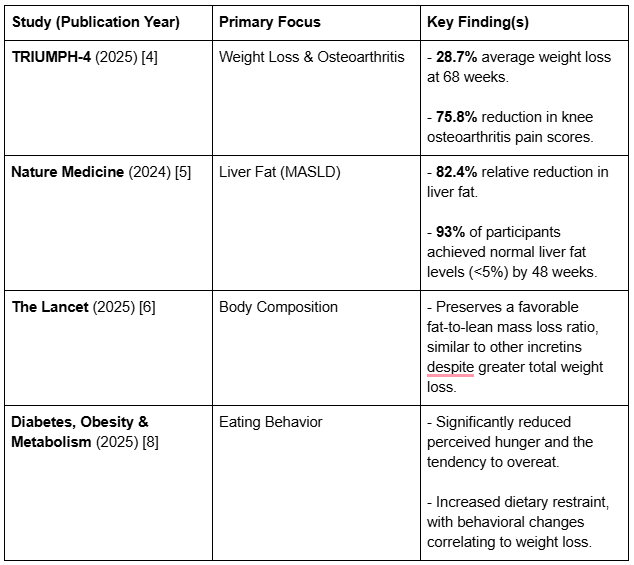
Summary of Key Retatrutide Clinical Findings (2024-2025)
The Power of Three: What Makes Retatrutide Different?
The excitement surrounding Retatrutide stems from its novel design as a “triple agonist” or “tri-agonist.” Unlike its predecessors, which target one or two metabolic pathways, Retatrutide engages three critical hormone receptors involved in appetite, energy balance, and glucose control: the glucagon-like peptide-1 (GLP-1) receptor, the glucose-dependent insulinotropic polypeptide (GIP) receptor, and the glucagon (GCG) receptor [1]. This triple-action mechanism is what sets it apart and underpins its remarkable efficacy.
To appreciate the innovation, consider the evolution of this class of medicine. The first wave, including drugs like Semaglutide (found in Ozempic and Wegovy), focused solely on GLP-1 receptor agonism. These were effective, primarily working by suppressing appetite, slowing digestion, and promoting insulin secretion. The next generation, exemplified by Tirzepatide (Mounjaro and Zepbound), added a second target, the GIP receptor, creating a dual-agonist effect that led to even greater weight loss and improved glycemic control [2].

Peptide Research, Done Cleanly — Peptide Partners. Independent HPLC/MS, batch COAs, and endotoxin screening to USP <85> validate identity and purity of peptides for research. Browse inventory and view certificates at Peptide Partners.
Retatrutide represents the third wave, incorporating the glucagon receptor into this synergistic symphony. The addition of glucagon agonism is a strategic masterstroke. While GLP-1 and GIP primarily regulate appetite and insulin, the glucagon receptor plays a key role in energy expenditure. Activating this receptor is believed to increase thermogenesis (the body’s production of heat) and promote fat oxidation, effectively turning up the metabolic furnace [3]. The result is a powerful combination: GLP-1 and GIP reduce energy intake, while glucagon increases energy expenditure. This dual approach of eating less and burning more is the holy grail of weight management, and Retatrutide is the first single molecule engineered to achieve it so effectively.
A New Benchmark in Weight Loss: The TRIUMPH-4 Trial
Just as the scientific community was beginning to process the impressive outcomes of dual-agonist peptides, the first Phase 3 results for Retatrutide set a new, almost unbelievably high bar. In December 2025, Eli Lilly announced topline results from the TRIUMPH-4 trial, a study that evaluated the peptide in adults with obesity and knee osteoarthritis. The findings were nothing short of spectacular.
Participants taking the highest dose of Retatrutide (12 mg) for 68 weeks achieved an average weight loss of 28.7% [4]. To put that in perspective, an individual weighing 250 pounds would have lost, on average, over 71 pounds. These figures represent the highest level of weight loss ever recorded in a large-scale, late-stage pharmaceutical trial for an obesity treatment, surpassing even the impressive results of its dual-agonist predecessor, Tirzepatide.
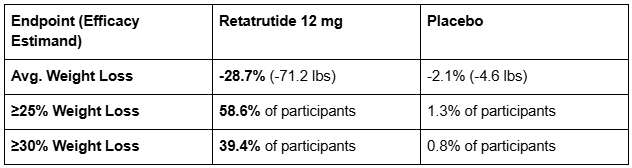
Source: Eli Lilly and Company, TRIUMPH-4 Topline Results, December 2025 [4]
Perhaps more importantly, the benefits extended far beyond the scale. The trial specifically enrolled patients suffering from knee osteoarthritis, a painful and debilitating condition often exacerbated by excess weight. The results showed that Retatrutide delivered substantial relief. Participants experienced up to a 75.8% reduction in their WOMAC pain scores, a standardized measure of osteoarthritis pain. In a remarkable post-hoc finding, more than one in eight patients treated with Retatrutide were completely free from knee pain by the end of the trial [4]. This demonstrates that the benefits of such profound weight loss are not merely cosmetic but can lead to life-altering improvements in mobility and quality of life, potentially delaying or even preventing the need for joint replacement surgery.
The Psychology of Weight Loss: Changing Eating Behaviors
The remarkable weight loss achieved with Retatrutide is not solely due to enhanced metabolism; it is also rooted in the peptide’s influence on the brain’s control of appetite and eating behavior. While the physiological effects on energy expenditure are significant, the psychological impact on hunger, cravings, and dietary choices is equally crucial. A study published in Diabetes, Obesity and Metabolism in September 2025 provided the first detailed look into these behavioral changes in adults with type 2 diabetes treated with Retatrutide [8].
The researchers used validated questionnaires to track changes in appetite and eating behaviors over 36 weeks. The results demonstrated a clear, dose-dependent effect. Participants on higher doses of Retatrutide (8 mg and 12 mg) reported significant reductions in both perceived hunger and “disinhibition”—the tendency to overeat in response to environmental cues or emotional triggers. Compared to placebo, these individuals felt less hungry and had more control over their food intake [8].
Peptide Research, Done Cleanly — Peptide Partners. Independent HPLC/MS, batch COAs, and endotoxin screening to USP <85> validate identity and purity of peptides for research. Browse inventory and view certificates at Peptide Partners.
Crucially, these self-reported behavioral changes were directly correlated with weight loss. The study found that greater reductions in body weight were significantly associated with decreased perceived hunger and lower disinhibition scores. Furthermore, participants on the highest dose of Retatrutide showed an increase in “dietary restraint,” indicating a more conscious effort to control food intake. This suggests that Retatrutide creates a powerful positive feedback loop: the peptide directly reduces the physiological drive to eat, which in turn makes it easier for individuals to adopt and maintain healthier eating habits, leading to more successful and sustainable weight loss. This synergy between physiology and psychology is a key component of Retatrutide’s success, empowering individuals to not just lose weight, but to fundamentally change their relationship with food.
Beyond the Scale: Tackling Liver Fat with Precision
While the weight loss numbers are headline-grabbing, some of Retatrutide’s most profound benefits may lie in its ability to resolve other metabolic dysfunctions. A prime example is its effect on metabolic dysfunction-associated steatotic liver disease (MASLD), formerly known as non-alcoholic fatty liver disease (NAFLD). MASLD is a silent epidemic, affecting an estimated 38% of the global population, and can progress to a more severe form, MASH, which can lead to cirrhosis and liver failure [5].
In a landmark Phase 2a substudy published in Nature Medicine in June 2024, researchers used advanced imaging (MRI-PDFF) to quantify changes in liver fat in participants with MASLD treated with Retatrutide. The results were stunning. After just 24 weeks, participants on the higher doses of Retatrutide saw a dramatic reduction in liver fat.
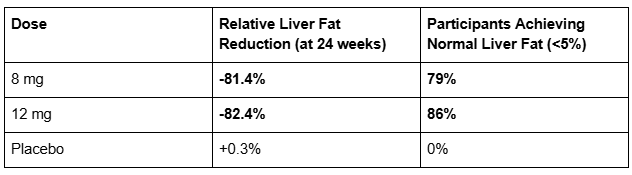
Source: Sanyal AJ, et al. Nature Medicine, 2024 [5]
By 48 weeks, an incredible 93% of participants on the 12 mg dose had achieved a normal liver fat content of less than 5%. The treatment effectively resolved the steatosis in nearly all subjects. This effect is likely driven by the glucagon receptor agonism, which is known to enhance fat metabolism directly within the liver. These findings suggest that Retatrutide could become a frontline therapy for MASLD, potentially halting or reversing a disease that currently has no approved pharmacological treatments in the US or Europe. By addressing the root metabolic drivers, Retatrutide is not just managing a symptom; it is resolving a dangerous underlying pathology.
Quality Over Quantity: The Body Composition Question
A reasonable concern with any therapy that produces substantial and rapid weight loss is the nature of that weight. Is it primarily fat, or is a significant amount of metabolically crucial lean muscle mass also being lost? This question is paramount for long-term health and wellness, as preserving muscle is key to maintaining metabolic rate and physical function.
A substudy of the Phase 2 trial, published in The Lancet Diabetes & Endocrinology in June 2025, specifically addressed this question using DXA scans to analyze changes in body composition [6]. The researchers sought to determine if the powerful weight loss from Retatrutide came at the cost of disproportionate muscle loss.
Peptide Research, Done Cleanly — Peptide Partners. Independent HPLC/MS, batch COAs, and endotoxin screening to USP <85> validate identity and purity of peptides for research. Browse inventory and view certificates at Peptide Partners.
The findings provided crucial reassurance. While any significant weight loss will involve some reduction in lean mass, the study concluded that the proportion of lean mass loss relative to total weight loss with Retatrutide was similar to that seen with other incretin-based obesity treatments. In other words, despite causing much greater overall weight loss, Retatrutide did not appear to be selectively catabolizing muscle tissue. A commentary on the study noted that, for the 12 mg dose, the placebo-subtracted weight loss of 15.4 kg comprised approximately 8.8 kg of fat mass and 5.8 kg of lean mass [7]. This suggests that most of the weight lost is indeed fat, and that the therapy maintains a favorable body composition profile. This is a critical finding, indicating that Retatrutide achieves its powerful effects by preferentially targeting adipose tissue, preserving the lean mass that is vital for a healthy metabolism.
The Horizon for Retatrutide
The clinical data emerging on Retatrutide is painting a clear picture of a peptide with transformative potential. The unprecedented level of weight loss, combined with profound improvements in comorbidities like osteoarthritis and fatty liver disease, and a reassuring body composition profile, places it in a class of its own. The ongoing TRIUMPH clinical trial program, with seven additional Phase 3 readouts expected in 2026, will further clarify its role in the treatment of obesity and type 2 diabetes [4].
For those in the wellness and longevity space, Retatrutide represents more than just a powerful tool. It is a validation of a systems-based approach to health. By targeting multiple interconnected metabolic pathways, it demonstrates that we can achieve holistic improvements that go far beyond a number on a scale, enhancing quality of life, reducing pain, and resolving organ-specific pathologies. The era of the tri-agonist has arrived, and the future of metabolic medicine looks brighter than ever.
Want to dive deeper? Join the Peptide Partners Discord for exclusive deep dives on topics like Retatrutide, real-time peptide discussions, and affiliate opportunities. Connect with our community for the latest insights and updates.
References
[1] Coskun, T., Urva, S., Roell, W. C., Qu, H., Loghin, C., Moyers, J. S., O’Farrell, L. S., Briere, D. A., Cui, X., & Haupt, A. (2022). LY3437943, a novel triple glucagon, GIP, and GLP-1 receptor agonist for glycemic control and weight loss: From discovery to clinical proof of concept. Cell Metabolism, 34(9), 1234-1247.e9. https://doi.org/10.1016/j.cmet.2022.07.013
[2] Jastreboff, A. M., Aronne, L. J., Ahmad, N. N., Wharton, S., Connery, L., Alves, B., Kiyosue, A., Zhang, S., Liu, B., Bunck, M. C., & Stefanski, A. (2022). Tirzepatide Once Weekly for the Treatment of Obesity. New England Journal of Medicine, 387(3), 205–216. https://doi.org/10.1056/NEJMoa2206038
[3] Gnad, T., Scheibler, S., von Kügelgen, I., Scheele, C., Kilić, A., Glöde, A., Hoffmann, L. S., Reverte-Salisa, L., Horn, P., Mutlu, S., El-Tayeb, A., Ku, M., Kretz, O., Rulands, S., Bange, T., Vogl, F. M., Hrabě de Angelis, M., Schürmann, A., Müller, T. D., & Pfeifer, A. (2016). Glucagon-induced browning of white adipose tissue is a FGF21-dependent process. Cell Metabolism, 24(6), 849-862. https://doi.org/10.1016/j.cmet.2016.10.005
[4] Eli Lilly and Company. (2025, December 11). Lilly’s triple agonist, retatrutide, delivered weight loss of up to an average of 71.2 lbs along with substantial relief from osteoarthritis pain in first successful Phase 3 trial [Press release]. https://investor.lilly.com/news-releases/news-release-details/lillys-triple-agonist-retatrutide-delivered-weight-loss-average
[5] Sanyal, A. J., Kaplan, L. M., Frias, J. P., Brouwers, B., Wu, Q., Thomas, M. K., Harris, C., Schloot, N. C., Du, Y., Mather, K. J., Haupt, A., & Hartman, M. L. (2024). Triple hormone receptor agonist retatrutide for metabolic dysfunction-associated steatotic liver disease: a randomized phase 2a trial. Nature Medicine, 30(7), 2037–2048. https://doi.org/10.1038/s41591-024-03018-2
[6] Coskun, T., Wu, Q., Schloot, N. C., Haupt, A., Milicevic, Z., Khouli, C., & Harris, C. (2025). Effects of retatrutide on body composition in people with type 2 diabetes: a substudy of a phase 2, double-blind, parallel-group, placebo-controlled, randomised trial. The Lancet Diabetes & Endocrinology, 13(8), 674-684. https://doi.org/10.1016/S2213-8587(25)00092-0
[7] Dirksen, C., & Madsbad, S. (2025). Body composition during major incretin-based weight loss. The Lancet Diabetes & Endocrinology, 13(8), 622-624. https://doi.org/10.1016/S2213-8587(25)00122-6
[8] Kanu, C., Boye, K. S., Poon, J. L., Goetz, I., Williamson, S., Lou, J., Hartman, M. L., Martin, C. K., & Coskun, T. (2025). Appetite, eating attitudes, and eating behaviours during treatment with retatrutide in adults with type 2 diabetes: Results of a phase 2 study. Diabetes, Obesity and Metabolism, 27(12), 6988-6998. https://doi.org/10.1111/dom.70097