
Peptides and the Placebo Effect
Why BPC-157 is long overdue for a clinical trial


I’m so excited to be sharing our second guest essay, “Peptides and the Placebo Effect,” by health and science journalist Saasha Govender.
Here, Saasha is examining an important issue in the peptide space: the placebo effect. We know from randomized controlled trials and actual scientific data that peptides can have a profoundly positive effect on physical health; what we don’t have is a robust enough system to test and determine the clinical implications (or lack thereof) for every peptide we see talked about in online forums. Anecdotal evidence may be enough for some, but only the scientific method can weed out the placebo effect.
This is valuable reading for anyone who’s interested in the science behind peptides and the rapid market growth we’re seeing in the peptide space.
— Peptide Reporter

Peptide Research, Done Cleanly — Peptide Partners. Independent HPLC/MS, batch COAs, and endotoxin screening to USP <85> validate identity and purity of peptides for research. Browse inventory and view certificates at Peptide Partners.
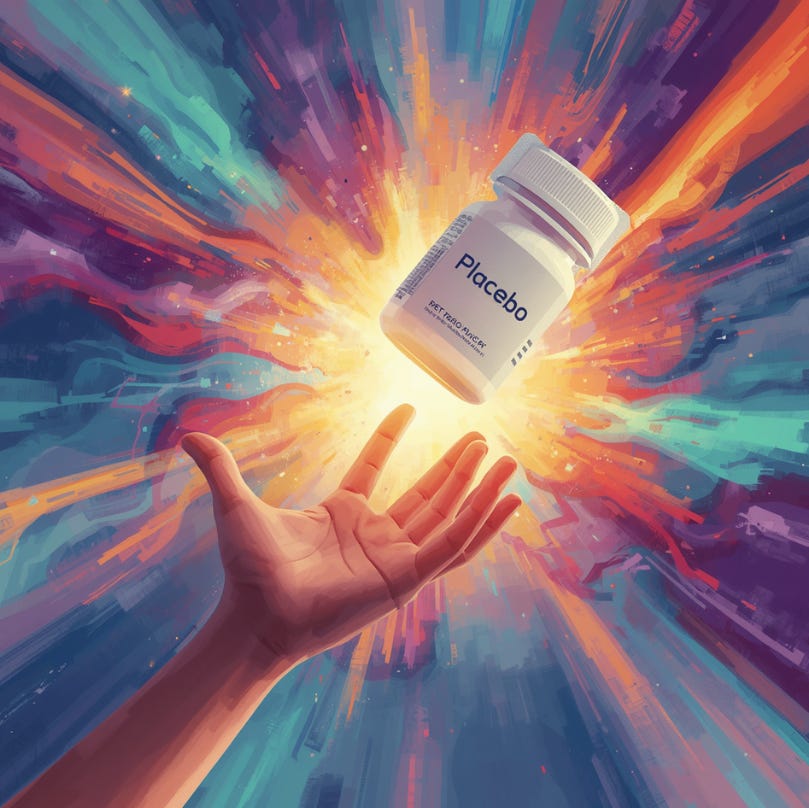
Peptides and the Placebo Effect: Expectations vs. Pharmacology
A user on r/bpc_157 posted before-and-after MRIs of a torn medial meniscus they’d carried since 2023. Over a year of PT yielded minimal progress. Then followed three months of BPC-157 and TB-500.
A follow-up MRI in April showed the Baker’s cyst had resolved; by the user’s own account, the clicking was gone, and gym sessions had returned to normal.
In an earlier post from the same account, the user had written: “Now this could be placebo, but I have also noticed faster recovery between sets in the gym, less soreness day to day, and overall reduced inflammation.”
That caveat is worth holding onto. It’s rare to see a self-experimenter name the placebo effect as a live possibility in the same breath as the benefits they’re reporting, and rarer still to watch them set the caveat aside and credit the compound anyway.
Here’s a sophisticated self-experimenter, biologically literate enough to verify their own batch via third-party testing, candid enough to flag placebo as a possibility. And yet he still ends up convinced the peptide is doing all the work.
It’s tempting to read his post as proof that the peptide works, or to wave it off as wishful thinking. Neither reading considers the very real possibility that the placebo response itself is doing something tangible and measurable.
Yet fifty years of research have shown the placebo effect to be a powerful, measurable, neurobiologically distinct phenomenon. For an audience that takes peptide pharmacology seriously, that distinction certainly has consequences.
The non-clinical conditions under which most people currently use research peptides (high expectation, ritualized administration, tight-knit online communities, injectable delivery) are conditions well-suited to a perpetuation of the placebo effect.
What we actually know about placebos
The modern science of the placebo effect begins with a 1978 study of placebo analgesia. Placebo analgesia means pain relief a patient feels because they believe they’ve been treated, even when the substance they were given does nothing on its own to neutralize pain signals in the body.
But the study showed the placebo relief patients experienced is physically real. Patients recovering from wisdom-tooth surgery were given a fake painkiller. Some felt real relief from it, and some didn’t. The ones who felt better were then given naloxone, a drug that blocks the body’s opioid receptors (the spots where painkillers like morphine normally work), and their pain came back. The patients the placebo hadn’t helped felt no change.
So naloxone could only undo relief the placebo had created in the first place. That meant the relief was running on the body’s own opioids: the fake pill had prompted these patients’ brains to release their own painkillers, triggered by nothing more than the expectation of treatment.
A pill with no active ingredient had produced a genuine chemical response. Subsequent neuroimaging work led by researchers like Fabrizio Benedetti and Tor Wager has mapped much of the underlying neural circuitry involved in generating a placebo analgesic response.
When the human brain releases endogenous opioids, it recruits the rostral anterior cingulate cortex, dorsolateral prefrontal cortex, and periaqueductal gray. These are regions tied to how we focus attention, regulate emotion, weigh expectations, and make decisions.
The periaqueductal gray, specifically, is where the brainstem turns down incoming pain signals. They are much the same areas a conventional painkiller would act on, which is part of why the placebo response can mimic a real drug.
Placebo responses in Parkinson’s disease produce measurable dopamine release in the striatum. Placebo immunosuppression, conditioned via prior pairing with cyclosporine, has been demonstrated in renal transplant patients. These are documented, measurable physiological events, not subjective reports massaged into a hopeful narrative.
There are a few features of the placebo response that are especially worth noting for anyone considering peptide therapy. The route of administration changes the size of the effect. Evidence from osteoarthritis trials and pain and itch studies shows injected placebos produce larger effects than oral ones.
Drawing up a substance, swabbing the skin, breaking the barrier, and injecting are themselves powerful psychological stimuli. An elaborate, invasive ritual tells the brain a potent treatment is underway, and the expectation it creates can drive a response even when the syringe holds nothing active.
So, subcutaneous self-injection, the dominant peptide administration ritual, sits squarely within the high-placebo-response zone. Conditioning compounds the response, too. When patients have prior experience with an effective drug, pairing that experience with a subsequent placebo produces stronger effects.
A peptide user who once had a cortisone shot to resolve a tendon issue brings that positive history into every BPC-157 injection. The earlier success has trained the body to expect relief from the act of injecting, so the ritual itself can produce a physical response before the compound does anything.
Expectation is dose-responsive. Subjects told they’re receiving an expensive drug report greater effects than those told the same drug is cheap. Branded placebos outperform generic ones, and elaborate rituals outperform simple ones. The peptide protocol (reconstitution with bacteriostatic water, insulin syringes, rotation of injection sites, AM/PM dosing schedules, week-long loading phases) is an effective amplifier.
Most troubling for the skeptical reading placebos work even when patients know they’re placebos. Ted Kaptchuk’s Harvard research group has shown across multiple trials that open-label placebos (pills explicitly labeled “placebo” and described as inert) produce clinically meaningful improvements in IBS, chronic low back pain, cancer-related fatigue, and migraine.
In their 2021 IBS trial, 69% of open-label placebo recipients reported clinically meaningful improvement, statistically indistinguishable from double-blind placebo. The conclusion follows directly. When recipients of an admitted sugar pill improve as much as anyone else, a glowing testimonial is no longer proof that the treatment itself worked. Which is exactly the problem with reading peptide success stories as pharmacology.
This holds even for the most credible reporter. Someone sophisticated, skeptical, biologically literate, posting their own MRIs, and openly naming placebo as a possibility still can’t answer the one question that matters: did the molecule actually do something in the body? Sincerity and self-awareness don’t substitute for a control group.
A peptide-shaped problem
BPC-157, one of the more heavily discussed peptide compounds in the wellness space, has generated a great deal of preclinical data in rodent models. And while this is genuinely interesting science, the human evidence base is something else altogether. There has never been a published, placebo-controlled randomized trial of BPC-157 in humans for any indication.
Vikas Patel, an emergency medicine physician writing in STAT in April 2026, laid out the entire human evidence base for BPC-157, and it comes to almost nothing: a Phase I safety trial of 42 healthy volunteers that was registered in 2015, cancelled in 2016, and never published; a retrospective case series of 12 knee-pain patients with no control group and no validated outcome measure; and a 2025 pilot safety study of two healthy adults who received intravenous infusions at a single private clinic in Florida.
Excluding that cancelled Phase I trial, which was halted in 2016 before it generated any data, the published human evidence for BPC-157 comes to just 14 subjects, by Patel’s count. (For broader context on the regulatory and scientific picture, STAT’s earlier reporting covers the field’s structural problems in more depth.)
Compared to the scant clinical research on BPC-157, Reddit testimonials about its miraculous effects are far greater in volume. In r/bpc_157 alone, there’s the post about the meniscus tear.
Posts about collarbone surgery recovery, runner’s knee, tennis elbow, lateral meniscus tears, hip pain, IBS, and ADHD interactions. All posted in the same week, and most of them clearly written by people clearly familiar with reconstitution, dosing schedules, and source verification.
Reddit’s broader peptide subreddits, Twitter’s peptide community, dedicated Discord servers, and an expanding ecosystem of podcasts and Substacks generate thousands of detailed reports on peptide self-experimentation per month
This means that a given peptide user could self-select into a community whose social currency is reporting benefits and read at least ten glowing accounts before their first peptide injection. They invest two to four hundred dollars per vial, which the contrast effect (expensive treatments produce larger placebo effects) converts directly into high levels of expectation.
This is precisely the user stimulus profile that placebo researchers have spent decades cataloguing as “maximally evocative.” And to be clear, none of this means that BPC-157, thymosin beta-4, or the broader class of peptide compounds don’t work. It simply indicates that the preclinical data are suggestive enough that proper human trials are well overdue.
In the absence of placebo-controlled evidence regarding the effectiveness of peptides in the human system, the peptide community is currently generating a large corpus of testimonials under conditions that maximize placebo response. Unfortunately, that same corpus can’t be treated as cut-and-dry evidence of pharmacological action.
The Power of an Anecdote
In the past, patients’ self-reporting has surfaced real signals that formal medicine kept missing. The off-label utility of low-dose naltrexone, the antidepressant properties of ketamine, the GI effects of GLP-1 agonists at sub-therapeutic doses are all examples of drug effects uncovered by.motivated self-experimenters that later trials confirmed. But anecdotes only operate well under specific conditions.
You need heterogeneous reporters, including people whose social standing isn’t tied to reporting a drug’s effects as purely beneficial (like a gymfluencer getting paid to sell a certain brand of peptides). You need an environment in which negative results can circulate as freely as positive ones.
You need reporters who can meaningfully distinguish between “my pain is gone” and “my expectation that my pain would resolve has been met.” The Reddit meniscus case is illustrative of this. The OP flagged placebo as a possibility, named it directly, but then hastily accumulated enough convincing evidence (clicking gone, MRI quieter, swelling resolved) to override their own caveat.
Testimonials alone aren’t enough under high-placebo-response conditions. The honest reading of the meniscus post isn’t that it’s false. The user is clearly reporting something real. What their testimonial alone can’t do is sort out the variables.
Was it the peptide itself that produced these physical changes, or the ritual of the peptide administration, the psychological expectation, the injury’s natural resolution over time, or some combination of all of the above? Without the expensive and slow infrastructure of randomized controls that the research field has largely declined to fund, there’s no way to know for sure.
Good peptide practice
Anyone building, prescribing, or writing about peptides needs to approach their work in a way that avoids both credulous instant adoption and knee-jerk skepticism.
Clinicians: patient-reported response can’t substitute for trial data. It’s not about dismissing what a patient has experienced, but holding two things in your mind at once: their experience is real, and what produced it is unresolved.
A protocol that “works for everyone in my practice” is another way of describing a high-placebo-response intervention in a self-selected cohort.
Vendors and entrepreneurs face a different set of challenges in the peptide space. The testimonial economy is a short-term asset and a long-term liability. The dynamics driving sales now will eventually meet a regulatory inflection point or the results of a published RCT.
Anyone with a serious commercial interest in peptides should be funding human trials at a modest scale on the compounds they sell most. These molecules don’t need to be miracles. They need to be bolstered by the same evidence base as any other prescription drug.
Science journalists have a similar problem. The credulous biohacker profile and the dunking wellness exposé both ignore the placebo literature entirely. The interesting story is what happens when consumer adoption races ahead of trial infrastructure.
The discipline this field needs isn’t more enthusiasm or more debunking. It’s the willingness to say: “This molecule may very well do everything its proponents claim, but the data we have can’t tell us that.”
The conditions under which these data are being generated would yield the same testimonials whether the compounds worked or not. Until then, every glowing report is evidence of something.
Pharmacology? A well-characterized neurobiological phenomenon doing its well-characterized work? For now, the report itself can’t say.
Saasha Govender is a science and health writer with 7+ years spent at the intersection of clinical research and real-world readers. From acute care and chronic disease management to pharmacology, functional medicine, and peptide therapeutics, her range covers the full spectrum of human health, including men's and women's wellness, hormones, fitness, and longevity. Saasha specializes in translating complex, evidence-based science into content that informs without oversimplifying, helping brands and readers make sense of treatments that actually matter.
 | A guest post by
|