
BPC-157: A Healing Peptide That Became an Internet Phenomenon
After the FDA's decision, a popular tissue-rebuilding peptide sits at an important crossroads


We’re excited to share this essay from freelance health and science journalist Tracy Miller. In light of the FDA’s advisory committee’s recommendation to include BPC-157 on its list of six peptides approved for bulk compounding, Tracy thought it would be worth taking a deeper look at the peptide’s research history. What she turned up should surprise no one: a need for more long-term human studies of this powerful healing compound.
The medical application of peptides is only helped, not hurt, by more and better data.
— Peptide Reporter
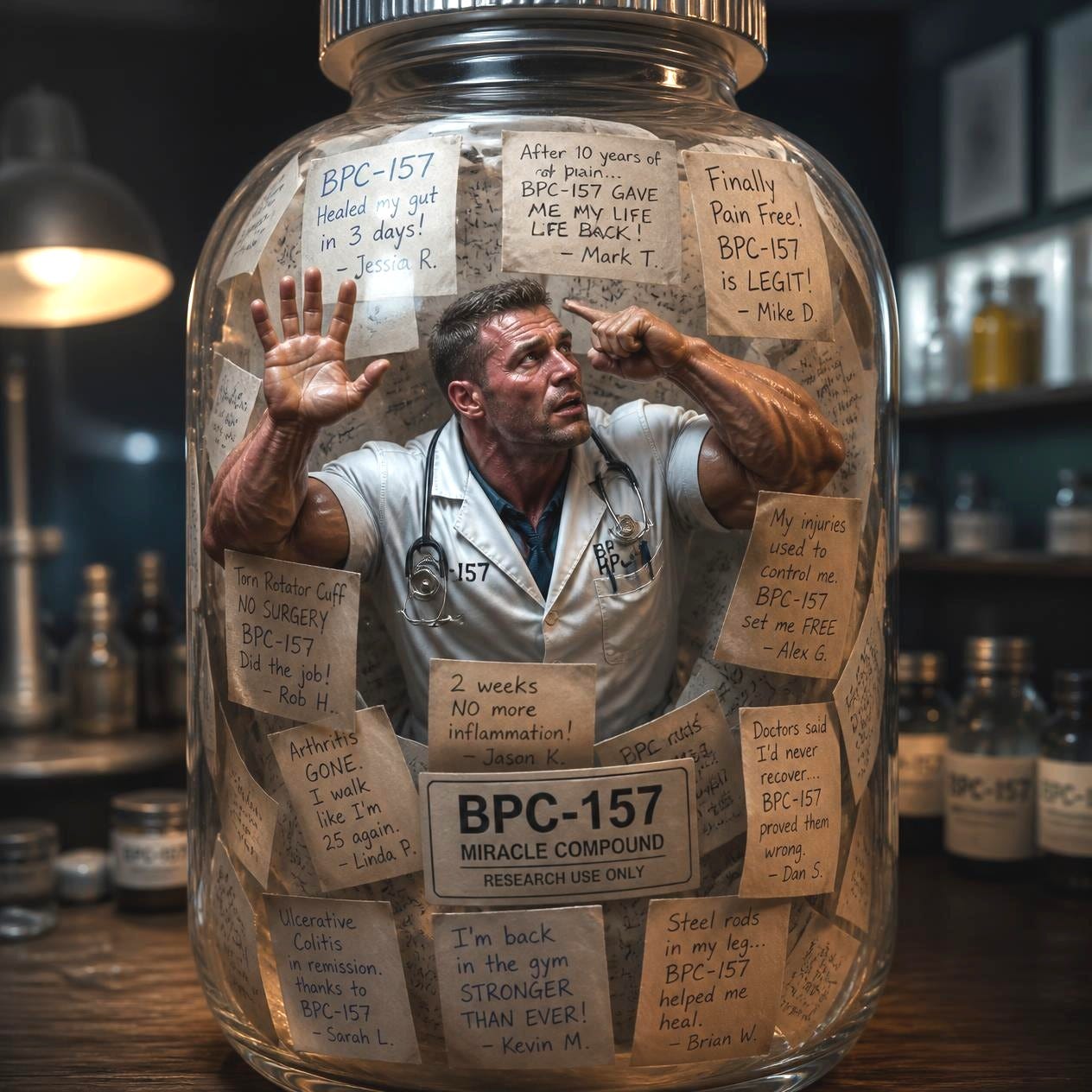
How BPC-157 Became the Internet’s Most Controversial Healing Peptide
Imagine you’ve been dealing with tendinopathy for months, so you open Google looking for clinical guidance: an explanation of the condition, evidence-based treatments, maybe a physician’s advice on why it isn’t healing. Before long, you encounter repeated references to a peptide called BPC-157.
At first, the results are scientific animal studies, mechanistic papers, cautious discussions of the compound’s potential. But somewhere around the third page of results, the focus shifts from scientific to sensational. You come across a shirtless man in a thumbnail holding a syringe next to the words I FIXED MY SHOULDER IN 10 DAYS. Below him is a Reddit thread with seven hundred comments, marathoners and powerlifters sharing injection protocols in the technical language shared by people convinced they’ve found a solution others have missed. Angiogenesis, FAK-paxillin signaling, nitric oxide upregulation.
Nearly everyone in these online discussions seems confident they’ve found the big healing peptide that mainstream medicine is willfully overlooking.
After reading so many confident medical claims, the obvious next question is whether these results hold up in humans. So you search for clinical trials and discover something surprising: not a single Phase I, II, or III trial of BPC-157 has been completed. The peptide’s future is being shaped not by new clinical evidence but by regulators.
The story of how BCP-157 reached this point is about more than a single peptide. It’s about how medical beliefs can spread so fast and far that their dwarf scientific evidence — and in some cases, even pre-empt it.
The molecule
In 1975, a second-year medical student at the University of Zagreb named Predrag Sikirić reasoned that because physical stress from injury, illness, or reduced blood flow can damage the stomach lining, the organ must also produce compounds for self-protection and repair.
Sikirić spent decades looking for these compounds, collecting gastric fluid from clinics and slaughterhouses. Eventually, he managed to isolate a fragment of fifteen amino acids he called Body Protection Compound. The “157” referred to July 15, 1990, a date once mistakenly thought to mark Croatia’s declaration of independence. This just goes to show how a compound’s name can contain a background reflecting things as various as a single scientist’s nationalism, hope, and the improvised nature of its discovery.
The mechanisms of Sikirić’s compound have been documented and are even quite impressive. In rodent and cell models, BPC-157 seems to encourage angiogenesis, collagen synthesis, and fibroblast activity while reducing inflammation, which could be beneficial for tendons and ligaments, tissues that struggle with blood supply issues. The peptide’s preclinical portfolio includes over a hundred papers covering tendon, gut, nerve, and cardiovascular repair.
These data would be enough to raise the curiosity of any serious scientist. Unfortunately, it’s almost entirely based on animal and cell studies, most of them published by Sikirić himself and his longtime collaborators.

Peptide Research, Done Cleanly — Peptide Partners. Independent HPLC/MS, batch COAs, and endotoxin screening to USP <85> validate identity and purity of peptides for research. Browse inventory and view certificates at Peptide Partners.
Where more evidence is needed
Without independent replication of Sikirić’s results, it will remain difficult to convince the broader medical field that this compound is a true therapeutic option. While reviewing the group’s patent documents, Anna Mapp, a University of Michigan chemist and president of the American Peptide Society, said the disclosures were too vague to allow other scientists to meaningfully evaluate what, exactly, had been discovered or how it differed from existing peptides. Thus independent scrutiny becomes difficult.
No human trial for BPC-157 trial has been completed. A 2015 study listed on ClinicalTrials.gov had its data withdrawn before being reviewed by others. Flynn McGuire, a chief medical resident at University of Utah Health, sought information after patients kept asking about a substance he hadn’t heard of. His published conclusion was that the compound should be treated as investigational. To the reporters of the investigation, McGuire was more direct: the compound “should not be used by humans.”
Eric Topol, director of the Scripps Research Translational Institute, was even more straightforward than McGuire: “None of [the experimental compounds] are proven.” He called it “extraordinary” that gray market human use was occurring in the absence of adequate clinical trials.
It’s important to remember that an absence of data on BPC-157’s effectiveness is not the same as evidence of its ineffectiveness. The peptide’s proposed mechanisms and animal data are intriguing enough to justify scientific interest, but they have yet to be confirmed in rigorous human studies. For now, the central fact is that BPC-157 remains profoundly understudied.
Why this one?
Here’s the question that should interest anyone involved with peptides: why has BPC-157 attained such a high profile, when there are a dozen more obscure research chemicals with similarly intriguing evidence of efficacy?
The answer is amplification. A trio of podcasters – Andrew Huberman, Gary Brecka, and Joe Rogan – turned personal accounts into widespread reach. “I had tendonitis in my elbow, I started using BPC-157 and it was gone in two weeks,” Rogan told his audience, a remark that has generated more attention than any paper Sikirić ever published.
As the Make America Healthy Again (MAHA) movement has gained influence, figures like Robert F. Kennedy Jr. and prominent wellness advocates have promoted greater access to experimental therapies while casting the FDA as an agency that too often blocks promising treatments. In that environment, BPC-157 has become more than a peptide; for many supporters, it symbolizes a broader belief that regulators are suppressing innovation rather than demanding stronger evidence.
As popular demand for peptides rises and direct-to-consumer distributors rise to meet it, the proliferation of gray market peptides has proven impossible for regulatory agencies to control. Tenille Davis, a pharmacist with the Alliance for Pharmacy Compounding, likened the FDA’s attempts to restrict gray market suppliers to an unending “game of Whac-a-Mole.” Meanwhile, clinicians like endocrinologist Edwin Lee, a co-founder of the Clinical Peptide Society, have campaigned for broader clinical access to peptides such as BPC-157 and thymosin alpha-1, arguing that current FDA restrictions limit treatment options despite growing clinician interest. Even FDA Commissioner Marty Makary has indicated willingness to explore the issue, stating the agency needs to differentiate between “harmless“ peptides and those that require serious scrutiny. Consequently, the market has expanded precisely because the science remains unsettled.

The users
You probably already know that the people self-administering BPC-157 are more diverse and reasonable than the stereotypes commonly associated with the term “biohacker.” The common theme in forums is not recklessness, but careful consideration. Where disorders like tendinopathy remain difficult to treat and the evidence-based options show only modest effects, BPC-157 enters with a welcome narrative.
One Reddit user, who later spoke with STAT News/Undark, described living with hypermobility spectrum disorder, a condition that at its worst made it “impossible to even walk around the block.” He wanted to strengthen the muscles around his joints, but was so injury-prone that workouts often left him feeling worse. BPC-157, he hoped, could break that cycle. Others approached it with a low-risk mindset, engaging in self-experimentation while “doing the math on species conversions” from rat studies.
It’s important to remember that even the most savvy self-experimenter can get caught in an epistemological trap. While an individual may think she’s producing meaningful data by monitoring her body’s response to a compound, she still exists within her own unique context. Drug trials, by contrast, involve large groups, and systematic measurement over time. Inconclusive data from a survey of one thousand patients can’t negate an individual’s claim that BPC-157 worked for them – indeed, no one but the individual can validate or disprove such a claim.
The takeaway
For those involved in creating, selling, studying, or regulating these molecules, BPC-157’s story is a well worth paying attention to. This peptide’s story illustrates how demand for a compound can obscure or even thwart evidence of its long-term efficacy. The institutions that once controlled medical knowledge haven’t lost their authority: they’ve lost their complete control over distribution, and are now at risk of losing public trust as well.
The FDA advisory committee has recommended that BPC-157 be added to the list of substances eligible for pharmacy compounding. The vote reflects the fact that demand for the compound is high, but it doesn’t answer the question that’s hounded the peptide for decades: what are its long-term effects on the human body?
Put simply: the rats have been remarkably cooperative. But humans are more complicated, and the scientific trials that could settle the debate still need to be completed.
Tracy Miller is a freelance writer covering science, health, technology, and society. Her reporting explores how institutions, research, and government decisions shape people's lives.